
Measuring the true value of AI: Beyond the buzzword
Introduction: Why ROI matters in AI investments
In a Global Capability Center (GCC) environment, AI is not a speculative technology; it’s a strategic investment in efficiency and competitive advantage. For us, ROI isn’t just a financial metric—it’s the validation that our projects are successfully moving from the PoC stage to scaled, enterprise value creation. Without a clear ROI framework, we risk turning potential into costly technical debt.
Defining ROI for Artificial Intelligence projects
The traditional ROI formula (Net Profit / Total Cost) is too simplistic for AI. A robust AI ROI calculation must account for unique, long-term factors:
- Total cost of ownership (TCO): Includes not just initial software/licensing, but the hidden costs of data cleaning, model training/retraining (every 12-18 months), MLOps infrastructure, and employee upskilling.
- Net benefit: Must capture both direct financial gains and strategic, future-proofing advantages.
Key metrics for measuring AI ROI
We need to track metrics that directly align with P&L levers:
- Productivity gains:
- Hours saved per employee per week (Quantify the time freed up from automation, e.g. in reporting, data entry or code review)
- Cost reduction:
- Cost per decision (Reduction in error rates or manual review loops)
- Reduction in operational costs (e.g. lower helpdesk volume)
- Revenue growth:
- Lead conversion rate uplift (AI-assisted sales/marketing)
- Time-to-market reduction (Faster product/feature delivery)
- Quality & CX:
- First contact resolution (FCR) rate (via AI-enabled support);
- Percentage reduction in quality defects (via computer vision/predictive maintenance)
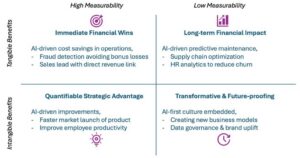
Types of AI ROI: Tangible vs intangible benefits – A 2×2 perspective
To gain a holistic understanding of AI’s value, we can map projects across two dimensions: Measurability (easy vs. hard) and Impact (tangible vs. intangible). This helps us strategically prioritize and articulate value.
Challenges in calculating AI ROI
If the median reported AI ROI is still low, it’s often due to these core measurement challenges:
- Attribution complexity: It is difficult to isolate whether a 10% revenue lift came from the AI model, a new marketing campaign, or general market conditions.
- Time discrepancy: Costs are upfront, but the maximum benefits often materialize over a 2–3 year period as models learn and adoption scales. A short-term calculation will severely underestimate the true ROI.
- Data quality overlook: Poor or siloed data is the silent killer of ROI. Teams frequently underestimate the time and cost required to clean and structure data before the model can deliver meaningful results.
It is clear that successful AI ROI requires disciplined execution, cross-functional ownership (not just IT/Data Science), and a commitment to tracking value over a multi-year horizon. We must define the baseline before deployment and treat our ROI projections as living, evolving frameworks, not static assumptions.
I’d love to hear from other leaders: What is the single most effective metric your organization uses to prove the ROI of an AI initiative? How do you tackle the “intangible” aspects of AI value?